
Worldbuilding is one of the most fun, and potentially most frustrating, parts of writing a novel. This is especially true if you’re writing fantasy or science fiction.
On the one hand there’s so much freedom! You can do anything you like! On the other… sometimes it feels like there’s too much freedom. If you can do anything, how do you choose what to do? How much detail do you need to know about your world, and how much of that needs to go into the novel?
My last novel was a fantasy novel and I definitely got hung up on the details. I love books about worldbuilding, whether that’s the World of Thedas book for the Dragon Age games, or the Dungeons and Dragons players handbook. It’s fascinating to read about the history and politics of the worlds and it can be tempting to do the same for your own world.
But before you go down a rabbit hole, take a moment to think about what you need. To take the World of Thedas books as an example, there is way, way more detail there than you’ll probably need. For those unfamiliar with Dragon Age, it’s a franchise based on long RPG video games that has expanded out to include books, comics, cartoons. It’s huge! The games themselves are dozens of hours long, and are created by teams that need detail and mechanics that you are a novel writer won’t need.
So think about that you do need.
Start with the where
One of the best ways to start is with a map. These are most well known in fantasy books, but it can be helpful to you if you’re writing scifi as well. Even if you’re already well into writing your novel, give this exercise a try – it might give you some useful ideas.
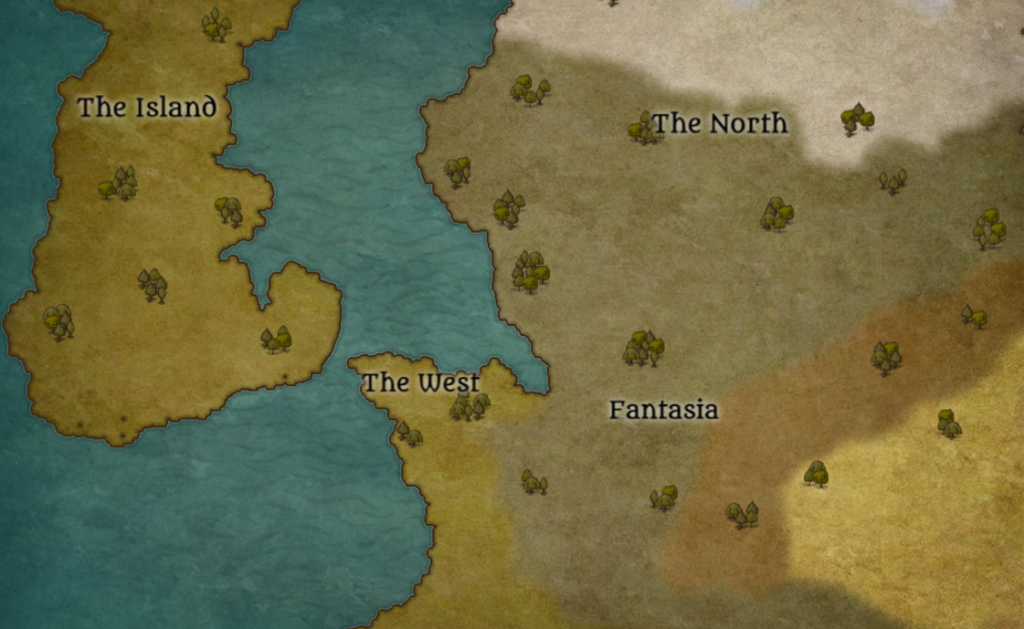
In the beginning you don’t need to get tons of detail or worry about getting things right, the idea is to think about the scope of your world. Even if your story takes place on a single spaceship or in a small village, think about other places that are mentioned in your story, or that are important in the history of your world. Mark them down on the map. Get a feel for how big or small your world is.
You can just sketch these maps on a bit of paper or you can use resources online like Inkarnate for fantasy maps or the Arkenforge Spaceship Generator.
The good thing about having a map is that it leads to other questions. How do people travel? What kind of people live in these places? How are the places shaped by history? If your characters live five hundred miles (or light years) from the rulers, how does that change how politics affect them?
You can go even deeper, inspired by this map. The kind of place they live will affect what your characters eat, what they wear, even the economy. At this point you’ll find it useful to do some research in how people in the real world are affected by the place they live, whether that’s the steppe or a tropical island. If you’re writing a story based solely on a spaceship, reading about the lives of people on oilrigs or in Antarctic bases might be useful.
Think about when
Now that you’ve got a flavour for your world, think about where in history they are. This doesn’t (just) mean is it the equivalent of Ancient Greece, but instead where in their history they are.
It can definitely help to think of some real-world equivalents (this is more useful for fantasy writers) as it gives you something of a shortcut to look up anything from the population of a town to the kinds of fabrics they wore.
More important, though, is what’s happened in the history of your world to create the place that your characters live. Think about Game of Thrones and how Westeros was shaped by the Targaryens. Think about Star Wars: A New Hope and how that world was shaped by the rise of the Empire.
What kind of powers created the world your characters live in, and how far removed are they from those huge events? What does that mean for your characters? If a coup happened a century ago, everyone might be complacent, but if it happened last week everything will be in upheaval. But again, think about distance, too – if your characters are indeed five hundred miles (or light years) from their rulers, it might not actually affect them all that much – until it does.
In Star Wars: A New Hope, Luke Skywalker is secluded on a backwater planet, a few decades after the rise of the Empire, and so he has no idea about the realities of the wider galaxy – until his aunt and uncle are killed by the Empire (spoilers for a forty-year-old movie). In Game of Thrones, on the other hand, Tyrion Lannister is right there in the heart of the politics of Westeros and right as everything is happening.
How is your character affected by the intersection of where and when they live?
If all of this has got your mind racing, my Fantasy Writing Planner or Science Fiction Writing Planner are just what you need to get all those thoughts out on paper (or on your screen).
Next week I’ll be writing about how much you need to know when it comes to worldbuilding, so sign up to my newsletter for a reminder so you don’t miss it – and get a free character workbook while you’re at it.